USDT moves $156B in small transfers as Tether eyes $500B valuation

ambcryptoPublished on 2025-12-13Last updated on 2025-12-13

Abstract

Tether (USDT) is rapidly expanding its influence beyond stablecoins, with $156 billion settled in small transfers under $1,000, indicating growing use for remittances and daily transactions in regions with limited banking access. The company is now targeting capital markets, exploring a stock sale that could value it at $500 billion and raise up to $20 billion, potentially tokenizing its shares for enhanced liquidity. Additionally, Tether is diversifying into acquisitions like a majority stake in Juventus FC, investing €1 billion, and expanding into AI, robotics, and commodity markets, where it became the largest non-central bank gold buyer with 116 tonnes in Q3 2025.

Tether [USDT] is getting bigger!

The company is scaling across payments, capital markets, and even legacy institutions. From a surge in small-dollar transfers to ambitions that stretch far beyond stablecoins, Tether is testing the limits of how big a crypto-native giant can go.

Small transfers, big deal

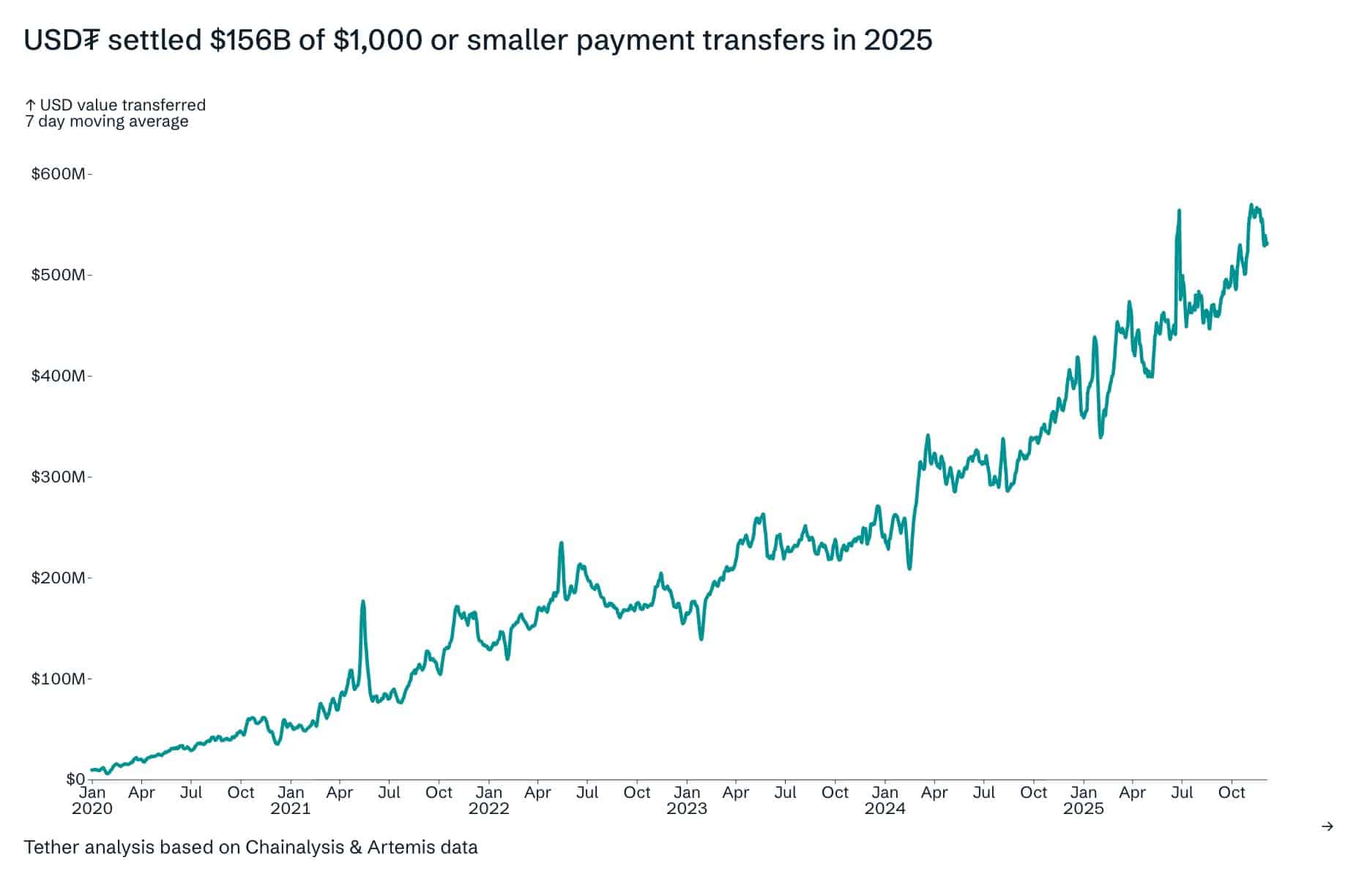
According to data shared by Tether CEO Paolo Ardoino on X, USDT settled $156 billion worth of transfers under $1,000. As the chart shows, small-value transactions have climbed steadily over the past few years, moving through 2024 and into 2025.

Source: X

The seven-day Moving Average is now consistently above $500 million, indicating high-frequency usage.

In regions where traditional banking is expensive or difficult to access, USDT has become a straightforward payment method for remittances and everyday transactions.

From payments to capital markets

That steady rise in small USDT transfers is a precursor for more.

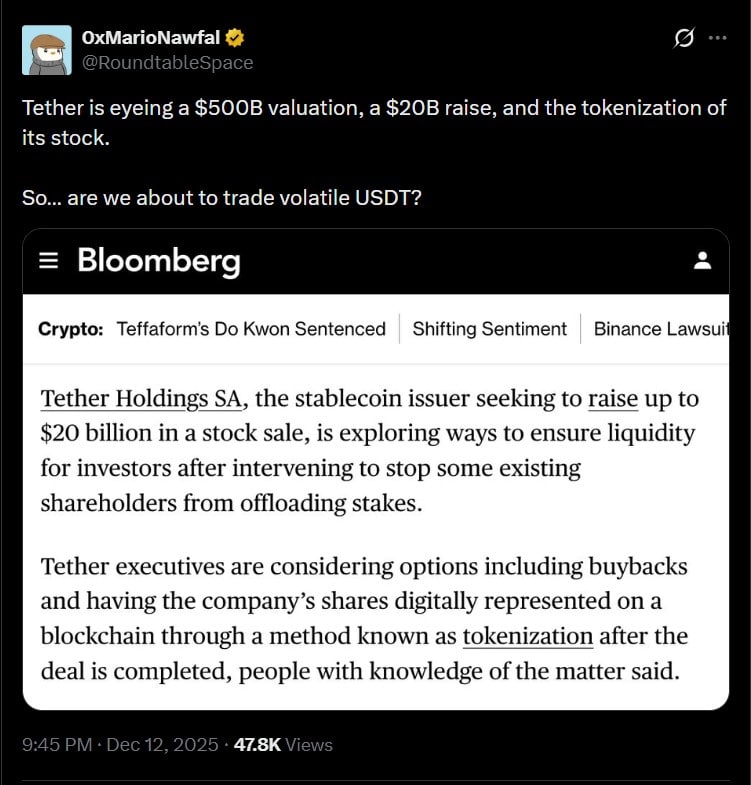
Beyond payments, the company is now eyeing the capital markets. According to a Bloomberg report, Tether is exploring a stock sale that could value the firm at around $500 billion and raise as much as $20 billion.

Executives are also considering tokenizing Tether’s shares on a blockchain to improve liquidity for investors.

Source: X

The move would take Tether from issuing the world’s largest stablecoin to turning itself into a tradeable, on-chain financial asset.

Tether beyond USDT

The company has submitted a binding all-cash proposal to acquire Exor’s 65.4% stake in Italian football giant Juventus FC, with plans to invest €1 billion into the club if the deal closes.

At the same time, Tether is pushing deeper into AI and robotics, backing an Italian humanoid robotics startup and supporting large-scale compute infrastructure for open AI development.

It is also deep in the commodity markets. In Q3 2025, Tether became the largest gold buyer outside central banks, holding 116 tonnes and driving fresh demand for tokenized gold.


Final Thoughts

  • $156 billion in small USDT transfers; Tether is becoming a global payments backbone.
  • A potential $500B valuation shows ambition to rival traditional financial giants.
Next: Analyzing MYX’s price surge – Is $3.45 the next stop?
Share
  • Share
  • Tweet

Related Reads

Anthropic Major Release: "The Founder's Playbook" - All 4 Stages of Entrepreneurship, Completely Reimagined with AI

**Anthropic Releases "The Founder's Playbook," Reimagining the Four Stages of Startups with AI** The logic of entrepreneurship is being fundamentally reshaped by AI. Anthropic's new handbook, "The Founder's Playbook: Building an AI-Native Startup," defines the AI-native startup as a new species: not a traditional company with AI tools, but a venture driven by AI from day one. The founder's role is transforming from a hands-on builder to a conductor or architect, orchestrating AI agents for execution while focusing on high-level judgment and strategy. Anthropic outlines a product matrix of Claude tools for different tasks: Claude Chat for interactive research, Claude Code for generating production-ready code, and Claude Cowork for automating knowledge-intensive workflows. The handbook structures the startup lifecycle into four stages, detailing core goals, pitfalls, and AI applications for each: 1. **Idea Stage**: Focuses on validating a real problem. The core challenge is avoiding confirmation bias. AI practices include using Claude as a "structured devil's advocate" to challenge assumptions and for automated market/competitor research. 2. **MVP Stage**: Aims to gather early signals of Product-Market Fit (PMF). Key risks are technical debt and scope creep due to rapid AI-assisted development. Recommended AI uses include maintaining project memory documents (e.g., CLAUDE.md), using Claude Code for structured coding, and automating user feedback analysis. 3. **Launch Stage**: Centers on establishing scalable growth, operations, and compliance. Challenges include accelerating technical debt and founders becoming bottlenecks. AI should be used to build an "operating system" for launch—automating routine tasks (scheduling, reporting, content) and code audits—freeing founders for critical decisions. 4. **Scale Stage**: Focuses on achieving sustainable business operations. The main challenge is delegating operational control. AI should be leveraged for differentiated marketing, operational optimization, and building competitive moats through data network effects. The handbook concludes that in the AI era, "Can we build it?" is no longer the primary constraint. The advantage shifts back to foundational strengths: **insight, judgment, and a deep understanding of a specific problem and audience.**

marsbit8h ago
Anthropic Major Release: "The Founder's Playbook" - All 4 Stages of Entrepreneurship, Completely Reimagined with AI

marsbit8h ago

Trading

Spot
Futures
活动图片